
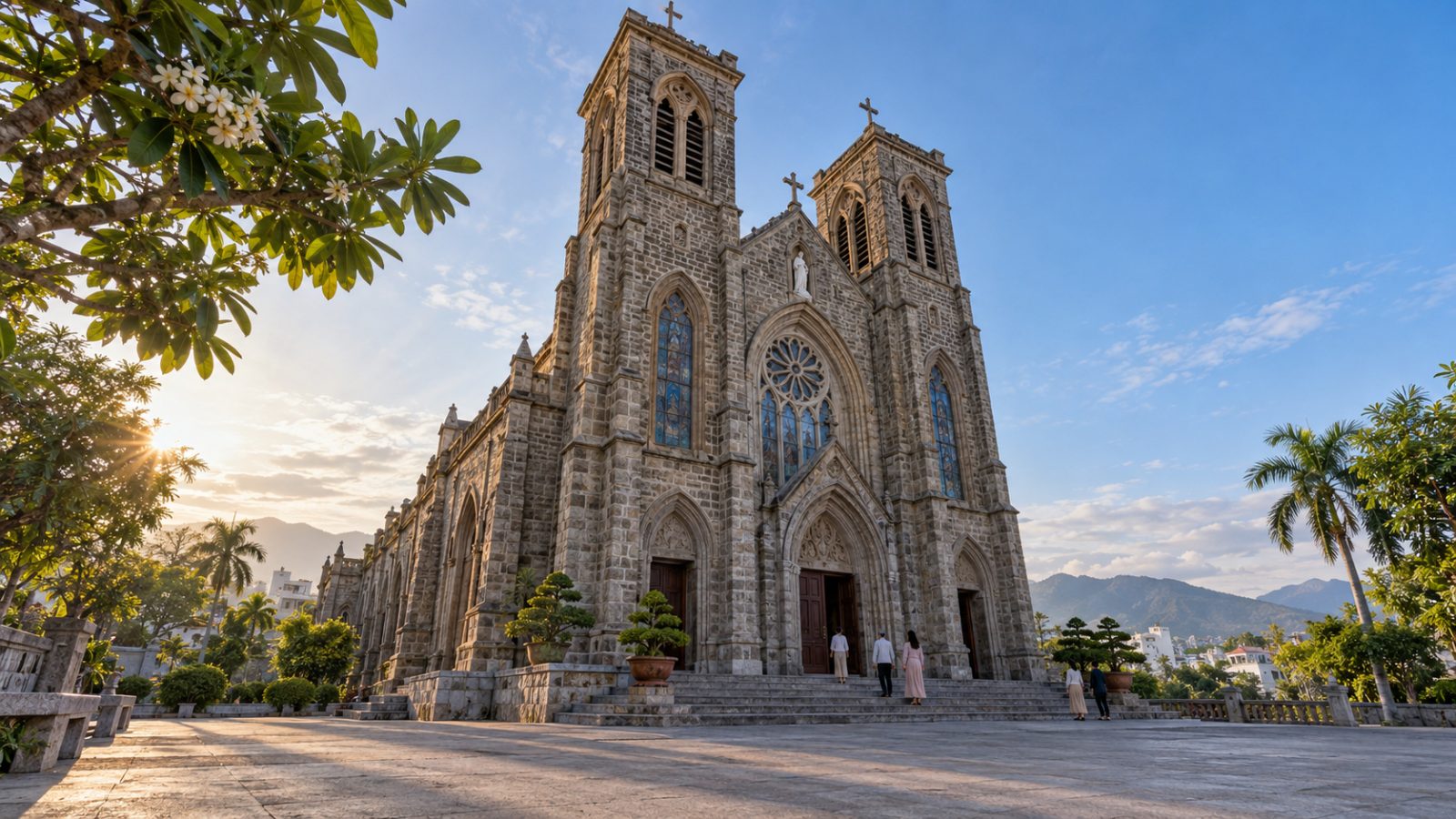

Nha Trang Cathedral sits on a small hill above the city’s traffic, built entirely of stone at a time when most churches in Vietnam were still going up in brick and plaster. Workers broke ground in 1886, and the building wasn’t finished until 1935, a stretch of nearly 50 years that shows in the weathered gray façade.
On maps and signs, you’ll see it listed as Christ the King Cathedral, Nha Trang Cathedral, or simply the Stone Church. All three point to the same twin-towered building that shows up on nearly every Nha Trang itinerary, whether or not the visitor is religious.
Nha Trang Cathedral: What You’re Looking At
Christ the King Cathedral sits on a small hill in Nha Trang, Khánh Hòa province, right next to the Nha Trang Station. It’s the mother church of the Roman Catholic Diocese of Nha Trang, built in Gothic Revival style with gray stone walls that darken with age. The tower reaches 38 meters (125 feet), high enough to spot from several streets away.
That status makes it more than a photo stop. Major Masses and diocesan ceremonies for the whole region take place inside. For most visitors, a casual look takes far less time.
Most people treat it as a quick stop. They climb the stairs, look at the façade, then step inside for a few minutes. There’s no museum collection here and no guided tour. The building itself is the draw.
Names You’ll See on Maps and Signs
It’s one church with several names, depending on the map or the sign you’re reading. The list below shows how to tell they’re all the same place.
- Nha Trang Cathedral or Christ the King Cathedral: the English names most guides and apps use.
- Nhà thờ chính tòa Kitô Vua: the Vietnamese name you’ll find on official signage.
- Cathédrale du Christ-Roi: the French name, left over from the colonial period.
- Nhà thờ Núi Nha Trang: literally “Nha Trang Mountain Church,” a nod to its hilltop site.
- Nga Sau Church or the Stone Church in Nha Trang: what locals tend to call it in conversation.
Why It’s on Most Nha Trang Itineraries
It’s one of the attractions that draws tourists to Nha Trang in the first place, and the location helps. The cathedral sits in the upper part of this coastal city, right above the train tracks. You’ll likely notice them already if you arrived by rail.
That makes it an easy add-on, and you can handle it quickly. You can see the hill, climb it, and be back on the street in under an hour.
Where It Is, When It’s Open, and How to Get There
Getting to the cathedral is simple once you know the landmark to aim for. Timing matters more. Visiting hours and prayer times don’t overlap, so arriving at the right time gives you a quiet look at the architecture instead of a crowded service.
Finding the Church on the Ground
The address is 31 Thai Nguyen, Nha Trang Ward, Khanh Hoa Province, right next to the Nha Trang Station. If you give that to a driver, they’ll know it as Nga Sau Church.
Another reference point is Intersection 6, one of the city’s recognizable junctions. It’s close enough to the cathedral to work as a drop-off point when an address alone doesn’t register.
The Route from Central Nha Trang
From Intersection 6, head onto Tran Phu Street. The church is about 10 minutes away from there, whether you’re walking, on a motorbike, or in a taxi.
That’s the route most visitors use, since Tran Phu runs along the coast and connects easily to hotels and the beachfront.
When to Visit, and What’s Free
The cathedral is open for sightseeing from 8am to 11:15am and again from 2pm to 4:15pm. Entry is free, with no ticket counter and no fee at the door.
Outside those hours, the building is in use for prayer. Weekday services run at 4:45am and 5pm. On Sundays, there are six services held at 5am, 7am, 9:30am, 3pm, 4:30pm, and 6:30pm.
If you want an empty nave and time to look around, stick to the posted visiting windows. Showing up during a prayer slot means you’ll be joining a service already underway, without the freedom to wander.
What You’ll See Inside and Out
A visit here follows a simple order. Start outside, then head in if the doors are open. The exterior is pure Gothic Style, built from stone with the pointed arches and vertical lines that define Gothic architectural features across the region.
Once you step past the entrance, the walk inside follows a straight path. The middle aisle runs past a sequence of 14 choirs, small framed scenes that trace Jesus’s suffering one station at a time.
Two spots are easy to miss if you only shoot the front façade. On the way in, the hallway has arched door architecture, a quieter echo of the Gothic lines up front. Take a second look there before you head inside.
For a different angle, walk around to Our Lady Square. From there, the side view shows the building’s full length, with the corridor and towers in profile. It’s a shot the front steps don’t give you.
The Façade, the Rose Window, and the Twin Towers
The façade divides into three visual zones from bottom to top. Low down is the main door. Above it, a large round stained-glass window decorated with roses marks the center. At the very top runs a corridor connecting two bell towers.
Those twin towers are the easiest way to spot the cathedral from a distance. They rise 12 meters above the roofline, tall enough to stay visible from several streets away near the station.
Inside the Nave: Light, Color, and the Stations
Visit in the morning and the hall is already full of light. It’s spacious and well-ventilated, with high ceilings that keep it airy even at midday.
Color comes from the rose window up front and smaller stained-glass panels along the walls, worked in green and red tones. When morning light passes through, it fills the hall with color. The effect feels closer to a lit stage than a quiet nave.
The stained glass tells its own stories. Watch for St. Joan of Arc and St. John Vianney, along with scenes from episodes in Jesus’s life worked into the panels.
Two rows of straight, neatly spaced seats line the center aisle. Follow the middle path, and it leads straight to a statue of Jesus at the front.
From Parish Church to Cathedral: A Short History
The building’s status as a cathedral came decades after it was built. French missionaries first founded a parish here in 1886, under the Apostolic Vicariate of Quinhon. The stone church itself wouldn’t rise for another 40 years.
Its promotion to cathedral happened in two steps. In 1957, Pope Pius XII erected the Apostolic Vicariate of Nha Trang through a document called Crescit Laetissimo. In 1960, the Diocese of Nha Trang followed, with Paul Raymond Marie Marcel Piquet, from the Foreign Missions, named as its first bishop.
One name tied to the parish’s early history is still marked on-site. Louis Vallet (1869–1945) devoted his life to the parishioners here and was buried on the grounds after his death. His grave remains part of the church today, a quiet link back to the mission era before the stone building existed.
Building the Stone Church: 1886 to 1935
Construction of the Stone Church in Nha Trang officially began on September 3, 1928, more than four decades after the parish’s founding. The building took five years to complete.
It was consecrated on May 14, 1933, under the title “Christ the King.” That date was also the cathedral’s grand opening. The bell came a year later, and Archbishop Colomban Dreyer, the Apostolic Delegate to Indochina, blessed it on July 29, 1934.
The bell tower itself wasn’t finished until December 3, 1935, two years after the main consecration. The gap between opening and tower completion is why the build stretched across nearly a decade, from the first stone to the last.
Stone, Scale, and the Mountain Behind It
Calling this a stone church is a plain description of material, not a style label. The style itself is Gothic Revival, built as a 20th-century echo of medieval Gothic forms instead of an original from that era. Either way, it stands as a unique Western-style structure on a hill above a Vietnamese coastal city.
The site itself has a story attached to it. Builders reportedly leveled part of Hon Mot mountain to make room for the foundation, which helps explain why the cathedral sits on a platform rather than flat ground.
Reading the Façade: Gothic vs. Gothic Revival
Gothic Style, in its original medieval form, grew out of cathedral building across Europe centuries ago. What stands in Nha Trang is Gothic Revival, a later recreation of those same forms instead of a direct survivor from that period.
You can see the difference in intent by looking at the rose window and the twin towers already described above. Those features show how Gothic Revival recreates a much older vocabulary on a 20th-century build.
How Big It Is, and How the Ground Was Prepared
Accounts of the construction describe cutting Hon Mot mountain in half and leveling the resulting land with 500 anti-personnel mines, clearing an area of 4,500 square meters for the build. This is the reported version of how the site was prepared, not an independently verified fact.
The finished cathedral covers a total area of more than 700 square meters on that platform. With the site-clearing story in mind, the footprint reads as a deliberate carve-out of the hillside instead of a natural flat spot.
Quick Answers About Nha Trang Cathedral
A few questions come up often enough to answer directly, especially around names and height. Nha Trang Cathedral appears under several labels on maps and signs, and in everyday conversation. The exact height depends on which part of the building you’re measuring.
Is Nha Trang Cathedral the Same as Christ the King Cathedral?
Yes. Christ the King Cathedral is the English name for the same building most people call Nha Trang Cathedral. On Vietnamese signage, it’s Nhà thờ chính tòa Kitô Vua or Nhà thờ Núi Nha Trang, and older French references use Cathédrale du Christ-Roi. Locals often just say Nga Sau Church or the Stone Church in Nha Trang.
How Tall Is Nha Trang Cathedral?
Reported figures vary depending on what’s being measured. The overall structure is cited at 38 meters (125 feet), while the twin bell towers themselves rise about 12 meters. From a distance, they’re still visible even without climbing closer.
What Do Locals Call Nha Trang Cathedral?
Around Nha Trang, you’ll hear it called Nga Sau Church or the Stone Church in Nha Trang more often than its formal title. The Vietnamese name Nhà thờ Núi Nha Trang, meaning “mountain church,” shows up on local signage and in casual directions too.